Missing Data II

DSCI 200

Katie Burak, Gabriela V. Cohen Freue

Last modified – 09 February 2026

\[ \DeclareMathOperator*{\argmin}{argmin} \DeclareMathOperator*{\argmax}{argmax} \DeclareMathOperator*{\minimize}{minimize} \DeclareMathOperator*{\maximize}{maximize} \DeclareMathOperator*{\find}{find} \DeclareMathOperator{\st}{subject\,\,to} \newcommand{\E}{E} \newcommand{\Expect}[1]{\E\left[ #1 \right]} \newcommand{\Var}[1]{\mathrm{Var}\left[ #1 \right]} \newcommand{\Cov}[2]{\mathrm{Cov}\left[#1,\ #2\right]} \newcommand{\given}{\ \vert\ } \newcommand{\X}{\mathbf{X}} \newcommand{\x}{\mathbf{x}} \newcommand{\y}{\mathbf{y}} \newcommand{\P}{\mathcal{P}} \newcommand{\R}{\mathbb{R}} \newcommand{\norm}[1]{\left\lVert #1 \right\rVert} \newcommand{\snorm}[1]{\lVert #1 \rVert} \newcommand{\tr}[1]{\mbox{tr}(#1)} \newcommand{\brt}{\widehat{\beta}^R_{s}} \newcommand{\brl}{\widehat{\beta}^R_{\lambda}} \newcommand{\bls}{\widehat{\beta}_{ols}} \newcommand{\blt}{\widehat{\beta}^L_{s}} \newcommand{\bll}{\widehat{\beta}^L_{\lambda}} \newcommand{\U}{\mathbf{U}} \newcommand{\D}{\mathbf{D}} \newcommand{\V}{\mathbf{V}} \]

Attribution


This material is based on content from the following sources:


Learning Objectives


By the end of this lesson, you will be able to:

  • Determine potential reasons why data are missing.
  • Detect instances of missing observations in a data set using a computer script and visualization.
  • Justify and apply strategies for managing the missing data.
  • Write a computer script to impute missing values when appropriate
  • Write a computer script to evaluate the impact that missing data can have on subsequent analyses through simulation.
  • Reflect on the consequences with regards to the conclusions of the chosen method.
  • Recognize the importance of utilizing domain knowledge when handling missing data.

Review

Last class we introduced the problem of missing data and learned that

  • missing data can reduce the sample size if only complete-cases are considered

  • missing data can distort who is represented and how variables are related if not handled appropiately

  • different missing data mechanisms need to be addressed differently

  • diagnosing visualizations and summary statistics are critical tools for making assumptions about missingness mechanisms

  • naniar package provides useful R functions which nicely integrate into the tidyverse workflow

Review

Last class we introduced the problem of missing data and learned that

  • missing data can reduce the sample size if only complete-cases are considered

  • missing data can distort who is represented and how variables are related if not handled appropiately

  • different missing data mechanisms need to be addressed differently

  • diagnosing visualizations and summary statistics are critical tools for making assumptions about missingness mechanisms

  • naniar package provides useful R functions which nicely integrate into the tidyverse workflow

Today, we’ll focus on how to analyze data with missing values

Missing values in R


Missingness can appear in different ways:

  • NA

  • NaN

  • NULL

  • 99, 9999, 888, or a similar out-of-range number

  • “Missing”, “Unknown” or another character string

  • “” empty cell, or ” ” blank space

Although all correspond to missing information, each have different effects on subsequent analyses.

You can convert these to NA at import or data wrangling stages

Missing missing values

If you fail to account for missing values, some functions will return NA. For example,

x <- c(-1, 0, 4, NA, 2)
mean(x)
[1] NA

The base R function na.omit() or the tidyr function drop_na() remove rows from data with any missing values

na.omit(x)
[1] -1  0  4  2
attr(,"na.action")
[1] 4
attr(,"class")
[1] "omit"

The boolean argument na.rm can be used in many functions to handle missing values

mean(x, na.rm = TRUE)
[1] 1.25

Analysis with missing data

Simulating data with missing values

library(naniar)
library(visdat)
library(ggplot2)

set.seed(123)

n <- 100 #sample size
x1 <- rnorm(n) 
x2 <- rnorm(n) + x1
y <- 2 * x1 + 1.5 * x2 + rnorm(n)

The simulated data

Adding missingness at random (MAR)

m <- sum(x1 > 0)

set.seed(123)
missing_idx <- sample(seq_len(m), size = round(0.5 * m))  # 50% missing

# introduce missingness
x2[x1 > 0][missing_idx] <- NA

#not in worksheet
x1[x1 > 0][head(missing_idx)] <- NA

simulated_data <- data.frame(x1, x2, y)

Identifying and quantifying

#percent of missing values in all data
pct_miss(simulated_data)
[1] 10.66667
# percent of rows with any value missing (`n_complete()` for counts)
pct_miss_case(simulated_data)   
[1] 26
simulated_data %>% 
  miss_var_summary()
# A tibble: 3 × 3
  variable n_miss pct_miss
  <chr>     <int>    <num>
1 x2           26       26
2 x1            6        6
3 y             0        0

A quick visualization

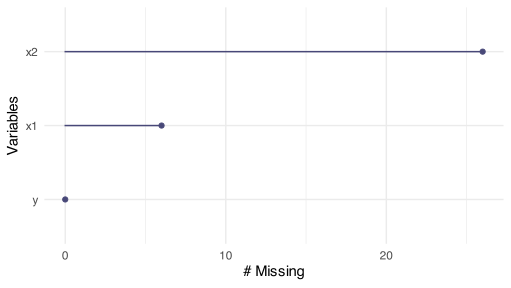
simulated_data %>% gg_miss_var() 

We can see the amount of missingness for each variable, but this summary does not show whether missing values occur together in the same observations.

Joint missigness
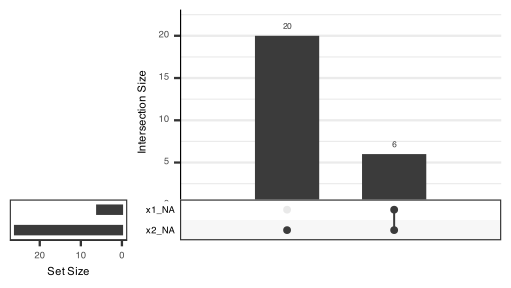
gg_miss_upset(simulated_data)

library(visdat)
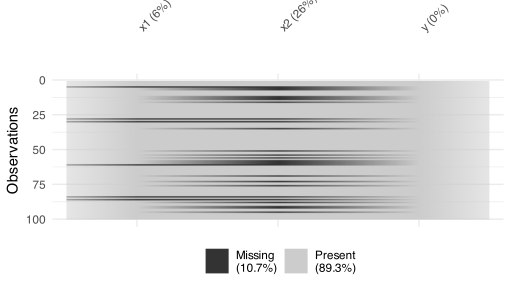
vis_miss(simulated_data)

Missing Mechanism?

# data frame with shadow columns
shadowed_sim <- simulated_data %>% bind_shadow()

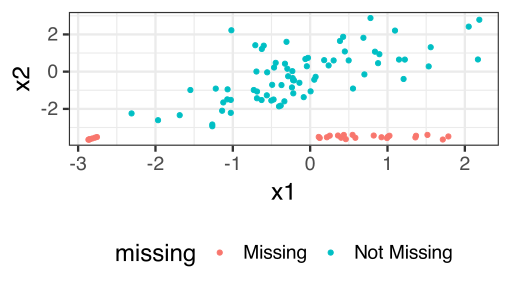
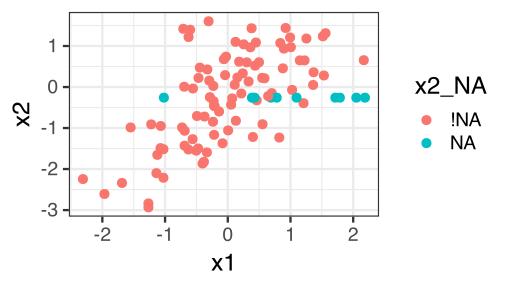
ggplot(data = shadowed_sim, aes(x = x1, y = x2)) + 
       geom_miss_point() + theme(legend.position = "bottom")

The plot suggests that data is not missing completely at random! but …

iClicker 1: can we rule out MNAR?

  • A. We can’t rule out MNAR

  • B. The plot suggests MAR and thus we rule out MNAR

  • C. We can rule out MAR

  • D. We can’t rule out MCAR

set.seed(123)

n <- 100
x1 <- rnorm(n)
x2 <- rnorm(n) + x1
y  <- 2 * x1 + 1.5 * x2 + rnorm(n)

set.seed(123)

# introduce missingness to top values in x2
cut <- quantile(x2, 0.9, na.rm = TRUE)

idx <- which(x2 >= cut)
x2[sample(idx, size = 10)] <- NA

simulated_data <- data.frame(x1, x2, y)

MAR vs MNAR

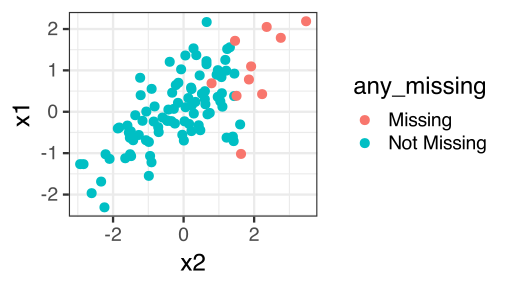
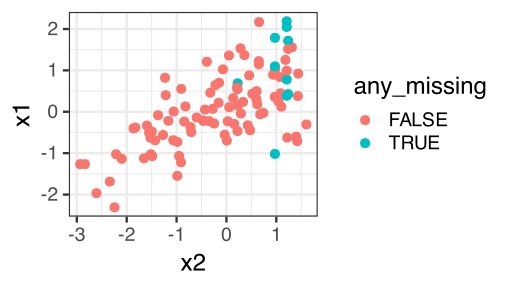
shadowed_sim <- simulated_data %>% bind_shadow()

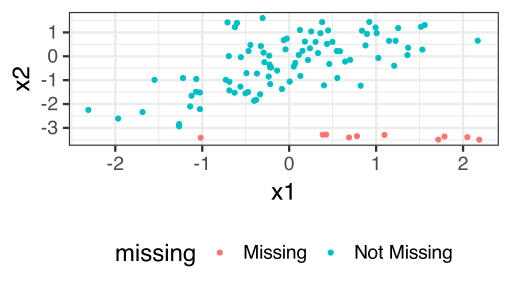
ggplot(data = shadowed_sim, aes(x = x1, y = x2)) + 
       geom_miss_point() + theme(legend.position = "bottom")

Because x1 and x2 are correlated, the missingness can appear to be related to x1. However, the missingness mechanism depends on the value of x2 itself, which makes it MNAR.

Caution

Visualizations can help rule out MCAR, but they cannot reliably distinguish MAR from MNAR.
When variables are correlated, an MNAR mechanism may look like MAR in plots.

CUTOFF FOR MIDTERM!

Imputation

Can we complete missing data?

  • Imputation is not always the solution to missing data

  • Imputation can reinforce existing biases.

    • For example, imputing variables like, age, race, gender may introduce biases to the analysis, particularly if missingness is related to social factors.
  • In other cases, imputation may mask trends in the data over time.

  • The percentage of missing data matters: less than 5% is generally considered safe to impute; 5%–20% is often acceptable but requires careful diagnostics; 20%–40% calls for caution; and more than 40% are typically unreliable.

  • When missing data cannot be recovered, it is important to understand why the data are missing and to analyze them accordingly.

Types of imputation

  • Listwise Deletion: retain only complete observations
    • Simple and widely used
    • Unbiased under MCAR
    • Biased under MAR in many cases
    • Inefficient (larger standard errors due to smaller sample size)
    • Discards potentially useful data

  • Deterministic Methods: Mean, Median, Mode Imputation
    • Replaces missing values with the mean, median, or mode of the observed data
    • Simple and fast to apply
    • Reduces variance
    • Introduces bias in relationships among variables
    • Ignores imputation uncertainty

  • Deterministic Methods: Statistical Prediction Models
    • Replaces missing values with predictions from an estimated model (e.g., linear regression) using observed values of other variables.
    • Preserves relationships between variables
    • Assumes relationships that may not be valid
    • Ignores imputation uncertainty.

Multiple imputation (MI)
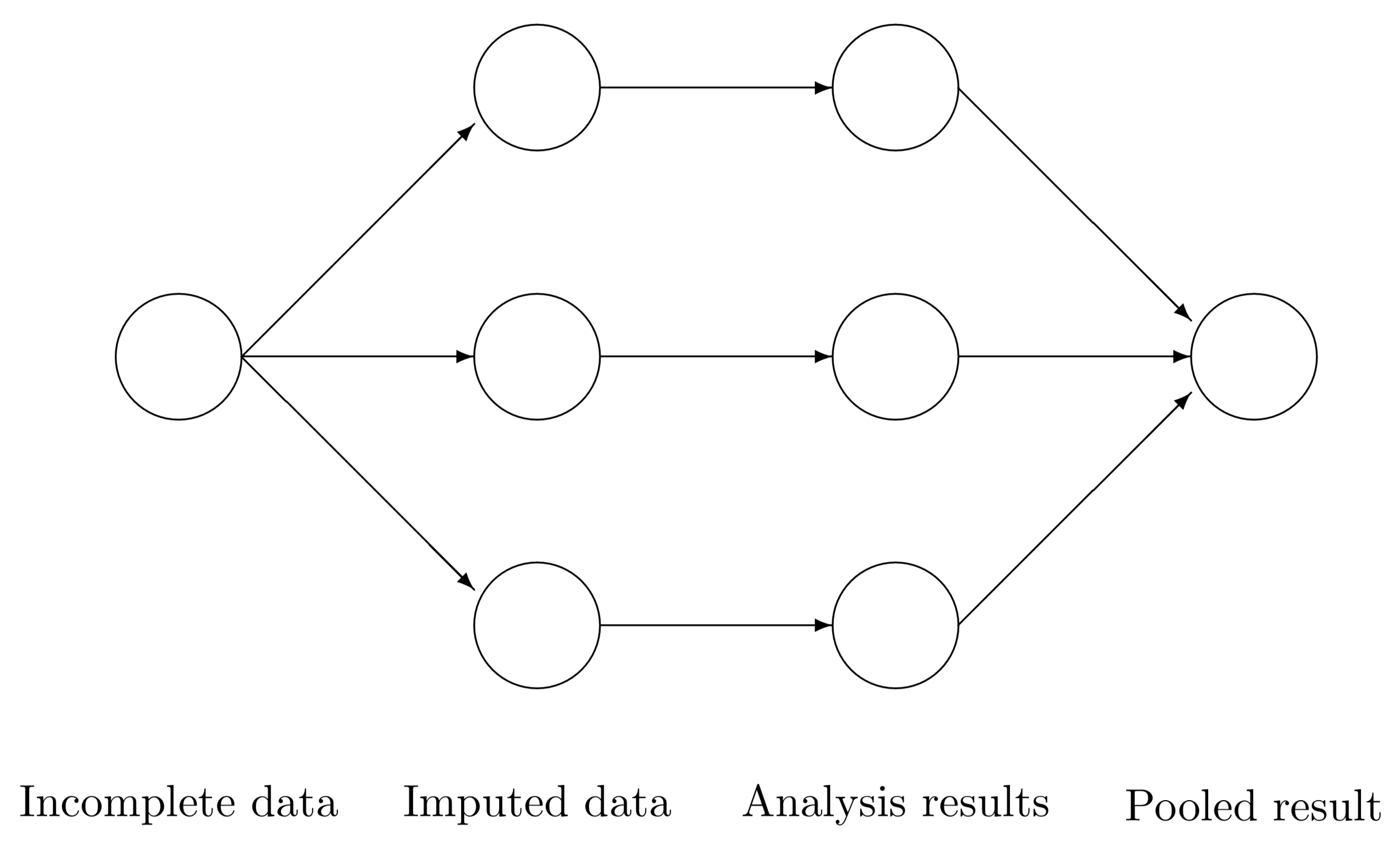
Figure from *Flexible Imputation of Missing Data

MI

  • Assumes that missing data is either Missing Completely at Random (MCAR) or Missing at Random (MAR).

  • Reflects the uncertainty inherent in the missing data by introducing many randomly imputed values.

  • Gives unbiased parameter estimates

  • Retain the statistical relationships present in the data

MICE: Multivariate Imputation via Chained Equations

Initialization: Replace missing values with simple initial guesses (e.g., mean or median of observed values).

Imputation: For each variable with missing values, impute it using the other variables as predictors, based on a specified method (e.g., PMM, regression, tree-based methods), including random variation.

Iteration (maxit): Cycle through all variables multiple times to update the imputations.

Multiple Imputations: Repeat to create m complete datasets.

library(mice)
mice_imp <- simulated_data %>%
    mice(m = 5, maxit = 10, seed = 123, printFlag =  FALSE)

#one dataset
comp_case <- complete(mice_imp, action = 1)

model_mice1 <- lm(y ~ x1 + x2, data = comp_case)
answer14 <- summary(model_mice1)
answer14

Call:
lm(formula = y ~ x1 + x2, data = comp_case)

Residuals:
   Min     1Q Median     3Q    Max 
-2.031 -0.769 -0.219  0.771  3.842 

Coefficients:
            Estimate Std. Error t value Pr(>|t|)    
(Intercept)   0.2910     0.1193   2.439   0.0165 *  
x1            2.0251     0.1688  11.999   <2e-16 ***
x2            1.5405     0.1354  11.376   <2e-16 ***
---
Signif. codes:  0 '***' 0.001 '**' 0.01 '*' 0.05 '.' 0.1 ' ' 1

Residual standard error: 1.155 on 97 degrees of freedom
Multiple R-squared:  0.8915,    Adjusted R-squared:  0.8893 
F-statistic: 398.6 on 2 and 97 DF,  p-value: < 2.2e-16

Visualizing imputation

Key Takeaways

  • Missing data do more than reduce sample size, they can distort who is represented and how variables are related

  • Diagnosing why data are missing is essential before choosing how to handle them

  • Complete-case analysis is a simple way to handle missingness but is unbiased only under MCAR and often fails otherwise

  • MNAR poses the greatest risk of bias when handled incorrectly

  • Visualization and diagnostics are critical tools for identifying missingness mechanisms

  • naniar integrates missing-data summaries and visualizations into the tidyverse workflow using tidy data principles

  • Many imputation methods exist but it is important to understand the risk of imputing!

  • Transparent reporting of imputation decisions is essential for reproducibility and ethical integrity.

Check additional functions in the Missing Book